
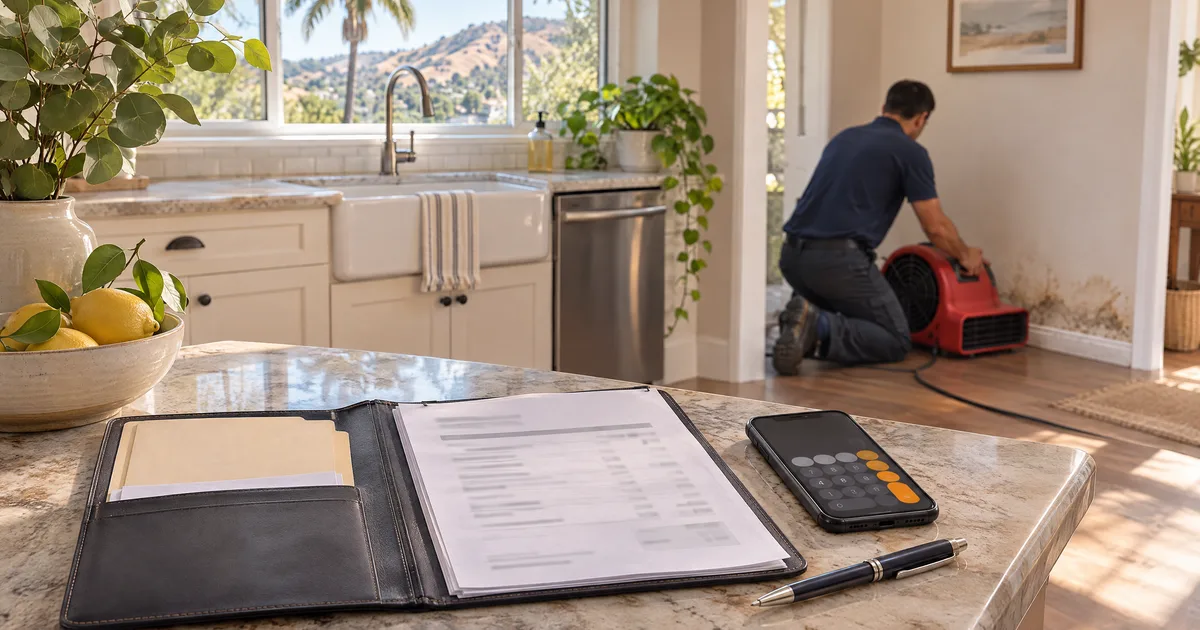
A water damage claim may make sense when the likely cost of the work is well over your deductible. If the estimate comes in close to or under your deductible, paying out of pocket is often simpler, because a claim would gain you little. Get an inspection first, so you're comparing your deductible with what the job should actually cost, not a guess.
If water is still coming in, start there instead. Shut it off at the main if you can do it safely, then call (888) 432-4373. The claim question can wait for the inspection.
How do you compare your deductible with the estimate?
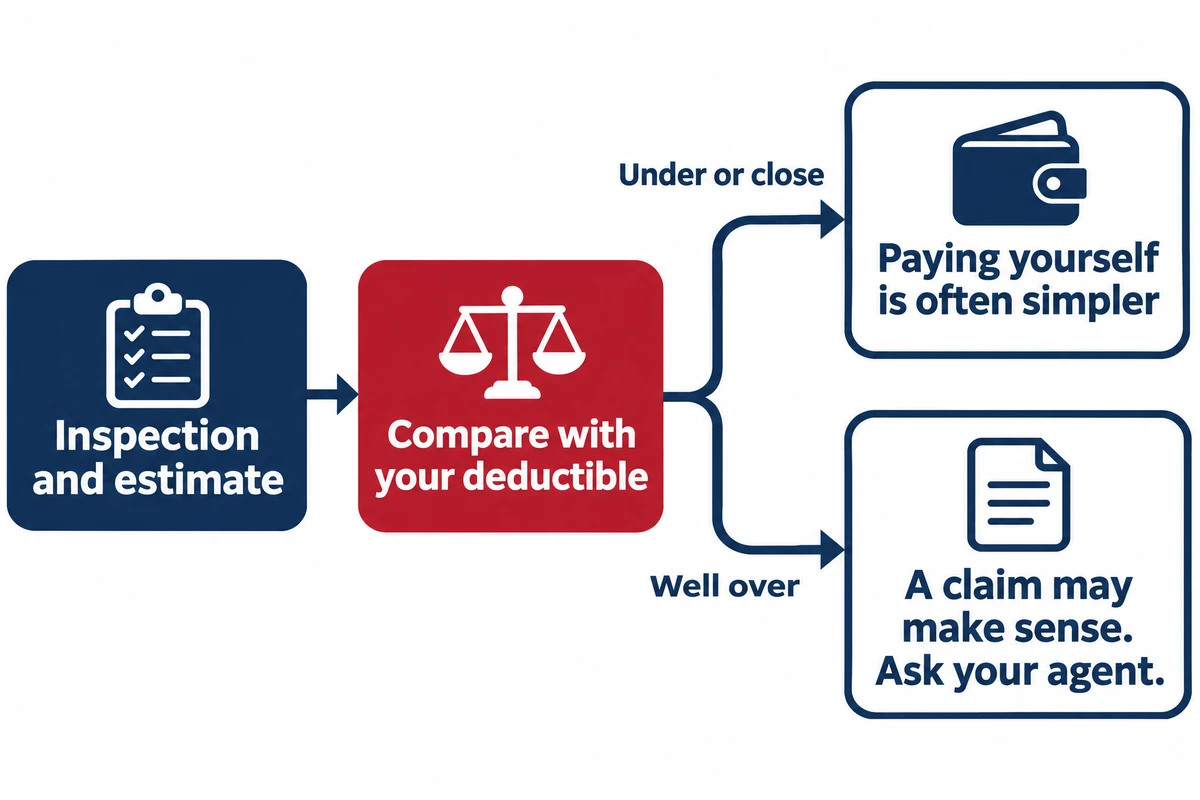
Put your deductible next to what the whole job should cost, and look at the gap. Your deductible is the part of a covered loss you pay yourself, and the insurer pays only what's above it. So if the work costs about the same as your deductible, or less, a claim gains you little. If the work is well over it, a claim may make sense.
On a Flood 1 inspection, the technician normally asks about your deductible and compares it with the likely claim amount. That discussion helps you decide whether to file or pay out of pocket. If you don't know your deductible, check your policy or ask your agent.
What does water damage restoration usually cost?
On a typical Flood 1 job, mitigation runs $3,000–$7,000, and repairs are estimated separately. Mitigation is the emergency stage: extracting the water, drying the structure and cleaning what the water touched. Drying typically takes 3–4 days, confirmed with daily moisture readings. Repairs, such as drywall, flooring and paint, typically take 2–6 weeks and get their own estimate.
Add both stages before you compare with your deductible. A job can look small when you count only the drying, and very different once repairs are added. Our water damage restoration process page explains each step.
Hidden water changes the numbers too. Water almost always spreads farther than you can see: under carpet pad, inside walls and into the subfloor. Slab leaks are the top cause of the water damage we see, and copper lines under the slab in many local 2000s-era homes wear through over time. A leak like that can look small from above. That's why moisture mapping comes before the decision, not after.
Should you call your insurance company first?
Usually not: in our experience, it works better to talk to a restoration company first and call your insurer once you have the facts. An inspection helps you explain where the water came from, how far it spread and what the work may cost. Without one, you're describing damage nobody has measured yet.
A better order is simple. Stop the water, take photos of the damage and get the inspection. Once you know the source, how far the water spread and what the job should cost, talk to your agent with real answers. Ask how your policy treats the cause of your leak. If you do file, Flood 1 bills all major insurers directly, and our team can help with your water damage insurance claim from the first call.
Can a water damage claim raise your premium?
A water damage claim can affect your future premium, so ask your agent what that could mean for your policy. Do it before you file, especially when the estimate is only a little over your deductible.
Use the inspection findings to prepare three questions for your agent:
- Does my policy cover the cause of this damage?
- How does my deductible apply to this claim?
- Could filing affect my premium later?
The estimate gives that conversation a starting point. Add the likely cost of mitigation and repairs, compare it with your deductible, then decide with your agent's answers in hand.
What happens after you decide to file or pay yourself?
Either way, nothing starts until you sign a work authorization, and the bill goes to whoever is paying: your insurer or you. Here's how a Flood 1 job runs:
- Inspection. The technician finds the source, maps the moisture and compares your deductible with the likely claim amount.
- Mitigation. If you want to go ahead, you sign a work authorization. The crew removes wet materials, sets drying equipment and monitors it, then closes out with a final cleaning and final moisture readings.
- Mitigation estimate. We write it up and send it to your insurance company, or bill you directly on a self-pay job.
- Repairs. If you want us to handle the reconstruction and repairs, you sign a separate work authorization. Your insurer or you sign off on the repair estimate before the work is done.
One thing to watch for, especially when you're paying yourself. Some restoration companies quote a small number, then add to the bill during mitigation. When homeowners can't pay, some put liens on their homes. Ask how the final bill is worked out before you sign anything.
When should you call Flood 1?
Call as soon as you find water, and before you call your insurer, so you decide with real numbers. A real person answers 24/7.
We offer a 60-minute response guarantee, and crews typically arrive in 45–60 minutes. Flood 1 has been local since 1997, with IICRC certified technicians, and is licensed, bonded and insured under CA License #911353. Crews head out from our Temecula base to homes across Riverside, San Diego and Orange counties.
Not sure whether to file? Call (888) 432-4373 and we'll walk you through your deductible and the likely cost.
FAQ
Is it worth filing a claim for water damage?
It may be worth filing when the likely cost of the work is well over your deductible. If the estimate is close to or under your deductible, paying out of pocket is often simpler. Get an inspection first so you compare real numbers.
Do I need to call my insurance company first, or a restoration company?
In our experience, call the restoration company first. An inspection helps you explain where the water came from, how far it spread and what the work may cost. Then talk to your agent with the facts in hand.
Will my homeowners insurance cover water damage?
That depends on your policy and on what caused the water. Many policies cover sudden, accidental water damage such as a burst pipe, and many exclude slow leaks and outside flooding. Ask your agent what yours says.
How much does water damage restoration cost?
On a typical Flood 1 job, mitigation (extraction, drying and cleaning) runs $3,000\u2013$7,000. Repairs are estimated separately and typically take 2\u20136 weeks.
Can a water damage claim raise my insurance premium?
It can. How much depends on your insurer and your policy, so ask your agent before you file, especially if the estimate is only a little over your deductible.
Do you work with my insurance company?
Yes. Flood 1 bills all major insurers directly. On a self-pay job, we bill you instead, and either way nothing starts until you sign a work authorization.
One team for the whole recovery
Let's get your property back on track.
Emergency help for homeowners and managed communities, 24 hours a day.